

Are clear aligners really suitable for children?
Should we wait until adolescence to correct a child’s teeth?
This question still divides many parents and even some practitioners.
On one side, the belief that “teeth move better in teenagers.”
On the other, new orthodontic recommendations that advocate intervention from age 6-7.
The dilemma intensifies with clear aligners: are they truly suitable for children or do they simply constitute a marketing argument?
Clear aligners today represent a serious alternative to traditional braces for children.
Invisalign First was specifically developed for children aged 6 to 10 in 2018 by Align Technology.
This technology adapts to the particularities of mixed dentition – the period when baby teeth and permanent teeth coexist.
The main differences from adult aligners:
- Softer material adapted to sensitive gums
- Eruption zones provided for incoming permanent teeth
- Reduced size for small growing mouths
- Compliance indicators to verify wear
Modern pediatric orthodontics favors early intervention between 6 and 10 years old, a period when jaws are still malleable and certain problems can be corrected more easily than in adolescence.
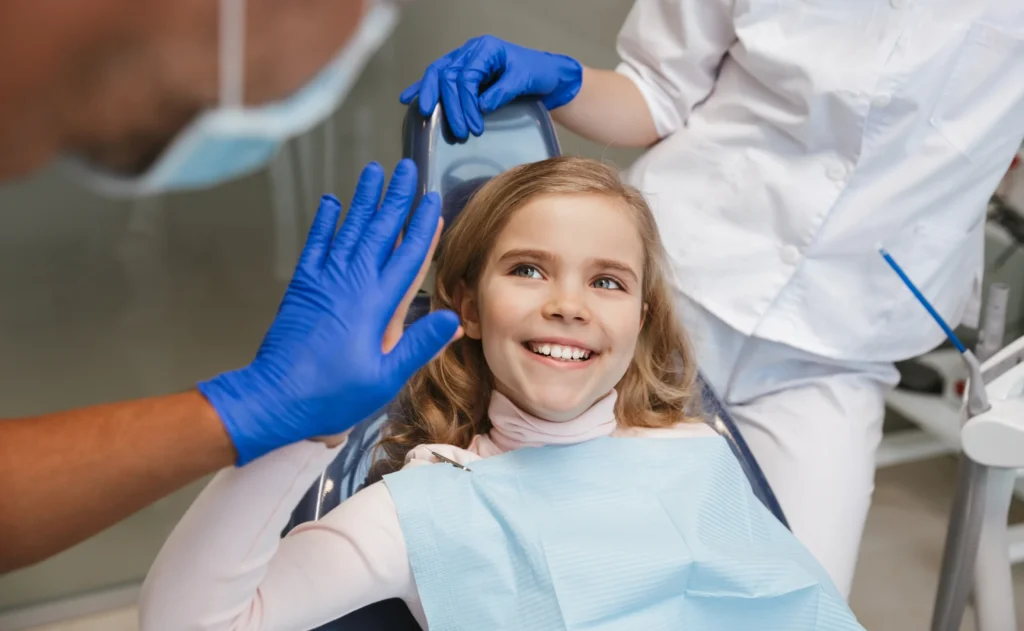
Invisalign First: designed specifically for children
Technology adapted to small mouths
Invisalign First is not a reduced version of adult aligners.
It’s a system specifically developed for children aged 6 to 10:
- Smaller aligners adapted to growing mouths
- Softer material for optimal comfort
- Eruption zones provided for permanent teeth that are coming in
- Colored indicators that fade to verify wear
The right time to act
At 6-10 years old, it’s the ideal age to correct certain problems:
- Jaws are still growing → we can guide them
- Baby and permanent teeth coexist → perfect timing for intervention
- Bad habits can be corrected more easily
- The child adapts quickly to treatment
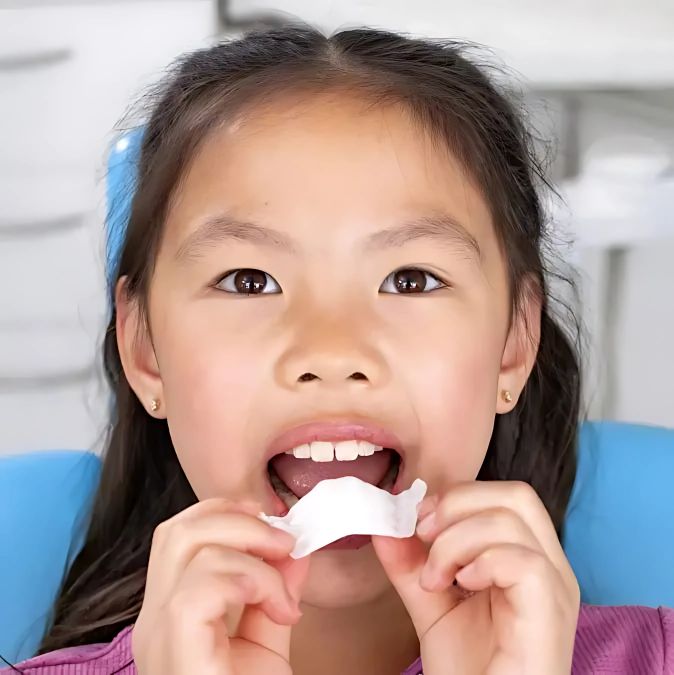
Why choose aligners for your child?
Total discretion at school
No more teasing about “metal teeth.”
With Invisalign for children, your child smiles freely:
- Total transparency → no one sees the appliance
- Self-confidence preserved during class photos
- No complex during the school period
Daily comfort
Metal braces can:
- Injure the inside of cheeks
- Create painful mouth sores
- Cause difficulty speaking the first days
Clear aligners are smooth.
No irritating metal. No wires that break.
Your child gets used to it in 2-3 days maximum.
Food freedom
With traditional braces, your child must avoid:
- Sticky candies
- Chewing gum
- Crunchy apples
- Popcorn
With Invisalign for children: they eat everything.
We remove the aligners for meals. It’s simple.
Easier hygiene
Brushing teeth with braces?
A nightmare for parents.
With clear aligners:
- The child removes their aligners
- They brush their teeth normally
- They clean the aligners with warm water
- They put them back in their mouth
Zero complications.
Conditions for success
Daily wear: 20-22h minimum
This is the crucial point.
The child must wear their aligners practically permanently.
Only removed for:
- Eating (30 min maximum per meal)
- Brushing teeth (10 min morning and evening)
- High-risk sports activities (depending on the sport)
Less than 20h of wear per day = ineffective treatment.
Essential parental support
You are the key to success.
An 8-year-old child cannot manage alone:
Your daily role:
- Check that aligners are worn upon waking
- Ensure they are put back after each meal
- Monitor brushing of aligners + teeth in the evening
- Encourage your child the first days
Our advice: create a routine with your child. Like for tooth brushing.
Regular follow-up at the clinic
The standard protocol provides for visits every 6-8 weeks.
These appointments allow to:
- Verify treatment progression according to initial planning
- Check effective wear thanks to integrated colored indicators
- Provide new aligners from the following sequence
- Evaluate the child’s adaptation and adjust if necessary
The orthodontist can quickly detect any deviation from the planned treatment and make necessary corrections to maintain treatment effectiveness.
Invisalign for children: not suitable for all cases
Let’s be honest.
Certain situations require other solutions:
Cases too complex
Children not yet ready
During your free consultation, we evaluate if Invisalign First is suitable for your child.
Our promise: we guide you toward the best solution, even if it’s not Invisalign.
How to properly prepare your child?
Explain the "why"
“Why do I need an appliance?”
Show them with our 3D simulation:
- What their teeth will look like after treatment
- Why it’s important for their health
- How long it will take
A child who understands cooperates better.
Present the advantages
“You can eat whatever you want.”
“No one will see your appliance at school.”
“Your teeth will be beautiful like movie stars’.”
Focus on what they gain, not on the constraints.
Create a fun routine
- Timer for tooth brushing
- Wear calendar with stickers
- Reward after each clinic visit
Orthodontics becomes a game, not a punishment.
Choosing the right practitioner for your child
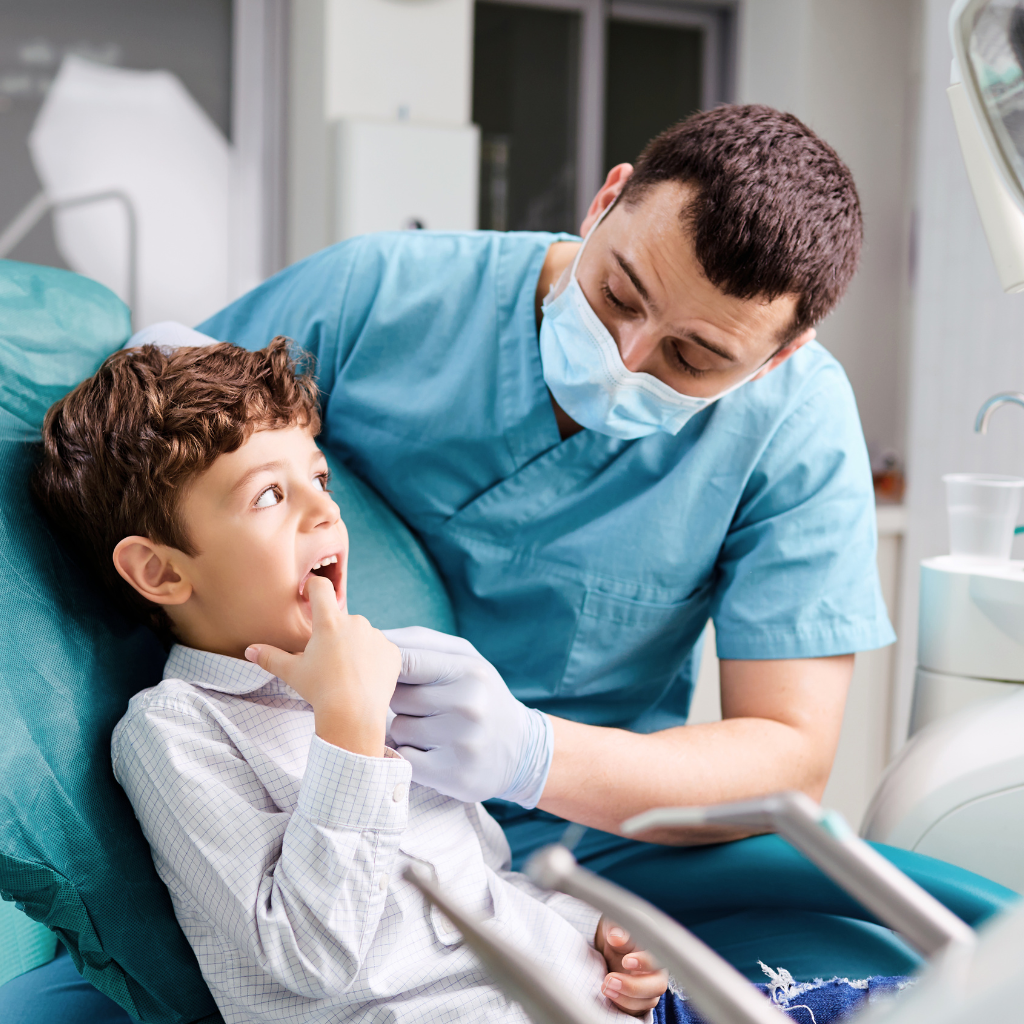
The importance of pediatric experience
Not all orthodontists master Invisalign First.
This technology requires specific training and clinical experience with children.
Criteria to verify:
- Certified Invisalign First training
- Significant experience in pediatric orthodontics
- Mastery of mixed dentition specificities
- Approach adapted to communication with children
Modern planning tools
3D technology revolutionizes pediatric orthodontics.
ClinCheck Pro software allows:
- Precise simulation of the final result before even starting
- Optimized planning of treatment duration (12-18 months on average)
- Anticipation of adjustments necessary according to evolution
This visualization helps the child and their parents better understand the process and maintain their motivation throughout treatment.
Summary: Is Invisalign suitable for your child?
YES, if:
- Your child is between 6 and 10 years old
- They can follow simple instructions
- You can accompany them daily
- Their clinical case is suitable
NO, if:
- The orthodontic problem is too complex
- Your child is not mature enough
- You cannot ensure daily follow-up
Ready to give your child the most beautiful smile?
-
Free consultation
-
Email:
-
Location
Netanya: Halamed Hei Street 5 | Tel-Aviv: Habarzel St. 11
Financing from 400₪/month
Diamond Provider clinic – Over 1000 cases treated
HymySmile: French expertise in invisible orthodontics in Israel